
Mutually Agreed to Part Ways.
Everyone and Everything in Fashion Is on a Trial Period.

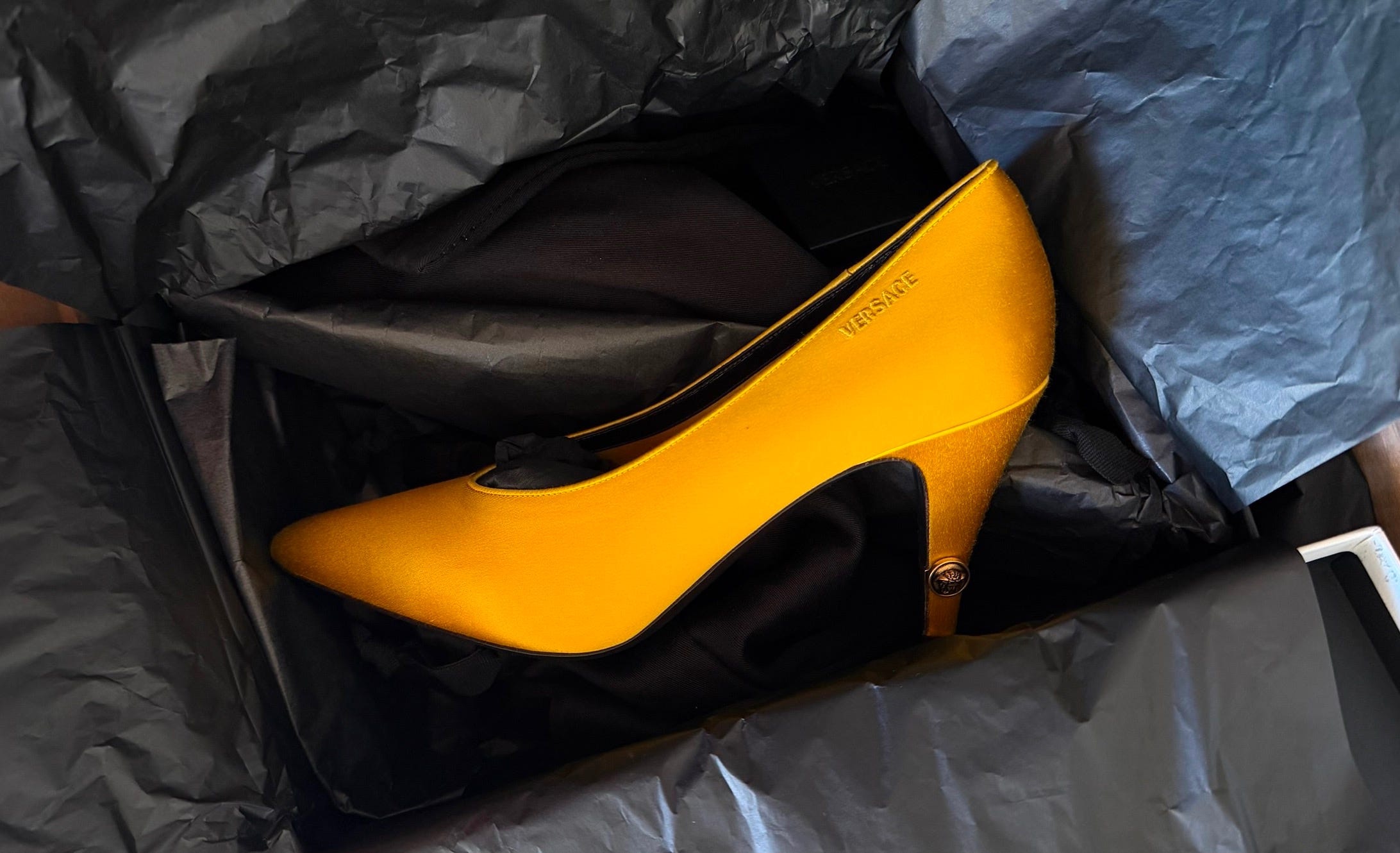
The other day the package arrived: inside were the bright yellow satin Gianni shoes, a Versace runway piece from Dario Vitale’s first collection for the house and, as it turned out, his only one. A Net-a-Porter sale find, with an additional 15% off at checkout, in my size, for a fraction of what they cost when they landed. This was not an impulse buy.
I repeat, not an impulse: I had considered buying them at full price. This was the precise configuration I have spent more than a decade training myself to read as fate — the grail, marked down, and mine. I have waited for considerably less. I have bought shoes in sizes that were never going to fit; there is a pair of Prada Chandeliers from SS07 in my wardrobe in a 36, and I wear a 38, and I regret nothing.
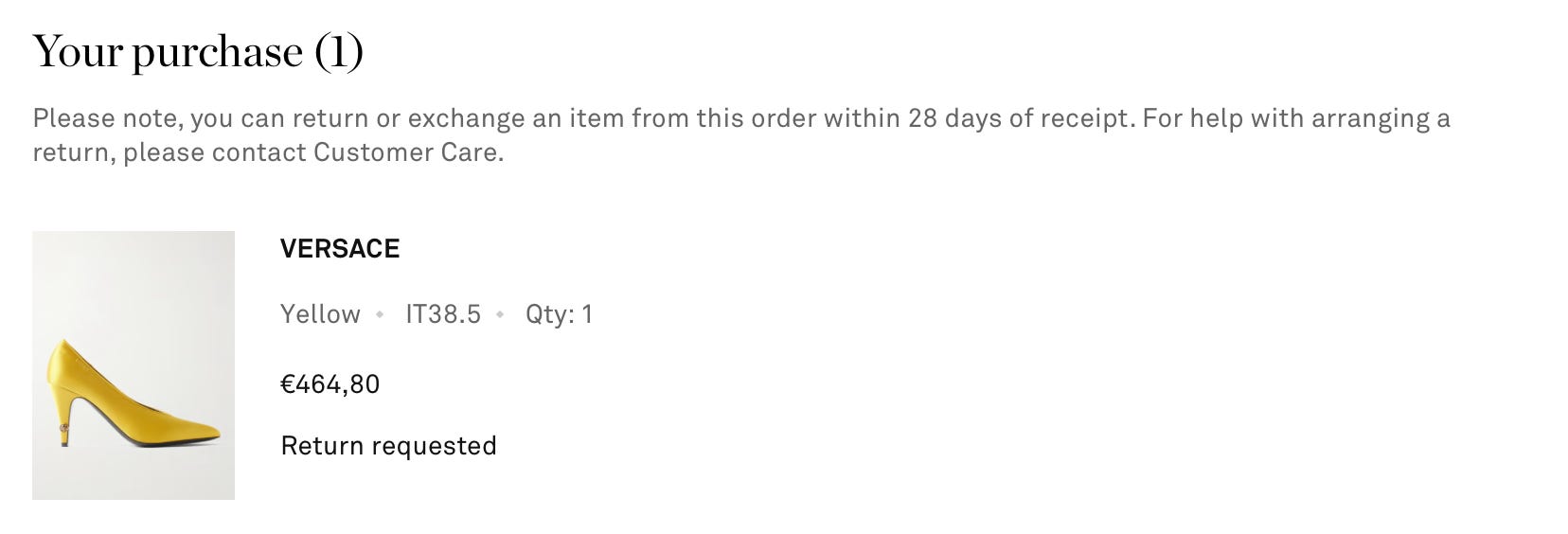
Less than 24 hours after the box arrived, I sent them back.
I photographed them first, and sent the picture to my girlfriend counsel. The verdict was unanimous: keep them, they’re fabulous. I knew they were fabulous. I used to design shoes for a living, which means I can’t look at a pair without taking them apart in my head, and these survived the dismantling. The satin was the right weight, the last was slightly narrow but still comfortable to wear, the cut was the one I refer to as a ‘sexy cut’: you can’t see the toes, but it elongates your foot. The yellow was not a safe yellow. Somebody had made real decisions. So did I: I packed them back, taped the box, printed the label, dropped it at the UPS point.
I don’t return grails. I return things that disappoint me, things that don’t fit — and half of those I don’t return either, I give them to girlfriends and call it generosity. The grail? Never. What’s next, I refuse a drink?
I have theories about why they went back, and the first one is chemical.
I’m on a GLP-1 for reasons involving blood tests (fitting into jeans I haven’t worn in 5 years is a nice side effect). The thing is, your GP doesn’t warn you that it doesn’t only quiet the noise around food — or mine just doesn’t have fashion patients. People, on social media at least, report the shopping going quiet too, and the drinking, and the scrolling. The research is early and nowhere near settled, but everybody’s talking about it, and I can’t claim I’ve simply grown wise. Wisdom has never once stopped me buying the right pair of shoes. Not having a stable income, historically, has stopped me even less.
Since it was a first (why would I ever return the shoes I wanted ever so badly?), I sat with it. I didn’t stop wanting the shoes. The wanting had already finished — it resolved at the checkout page: by the time the box arrived, the hunt was over. Which raises an unpleasant question about the last ten years of my life, but let’s park that.
I recognise exactly where I learned it — and so will you, the moment I say it out loud.
The industry pays for firsts. A debut collection gets the reviews, the sold-out pieces, the A-list front row; the fifth collection gets a slideshow and a sales figure nobody publishes. The appointment post gets more attention than anything the appointee actually goes on to design. So does the teaser, over the campaign it’s teasing.
Vitale showed his first collection for Versace in September — the first in the house’s history not designed by Gianni or Donatella. It was extraordinary. He went into the archive with a genuinely light hand and pulled out the Versace sleaze, the reviews were raving, and people who hadn’t thought about Versace in a decade started thinking about Versace. He’d pulled off the increasingly rare miracle of making a dusty self-repeating heritage house feel like it has a present tense.
Then, on 2 December, Prada completed its acquisition. Two days later the house confirmed his departure. He had been hired by the previous owners mid-sale, and before Versace he was a Prada baby — 15 years at Miu Miu — and the rumour is that Signora Prada, like an Italian mamma, doesn’t love it when her babies leave her.
The statement said the two parties had mutually agreed to part ways.
By December, the debut had already done everything it was ever going to be asked to do. Versace was interesting again, the archive had been reactivated, and Vitale’s name was permanently attached to a moment of genuine excitement about a house that needed one. He’d done the expensive part.
Most importantly: he didn’t fail. Let’s remember that.
And I would like to tell you I watched that happen from a critical distance, but I used to place people in this industry for a living. I spent 7 years on the hiring side of exactly this machine: sourcing the names, running the searches, watching appointments announced. The excitement is worth everything in the first week and nothing by year two — I've watched that enough times to know the schedule. I love this industry, the craft and the archive are real, and I helped run the part of it I find hardest to defend.
So when I say I recognised my own behaviour, I mean it fairly precisely. I did what I know corporations do. The difference is that shoes don’t have careers.
Though I should be careful with the tragedy here, because Vitale isn’t one. He got out with the rarest possible outcome: a debut everyone remembers and no time on the clock for it to go wrong. The usual version is worse — a designer gets three or four seasons, the numbers don’t move for reasons that were structural before they arrived, and the industry quietly files them under tried that, didn’t work. Sales are almost never a designer’s doing, and it almost never matters. Dario will have a house within the year, and it will be a house that hired him for what he actually did rather than for who was about to buy it.
The system worked out well for him precisely because it never got as far as judging his work. He'll be fine.
Meanwhile it took me two thousand words, a philosophy detour and an industry diagnosis to send back a pair of shoes, which suggests the problem here might not be the industry.
Какая изящная рифма и переплетения тем в тексте, большое удовольствие!